AGON by AOC Explains How OLED Gaming Monitors Are Evolving for Different Ways to Play
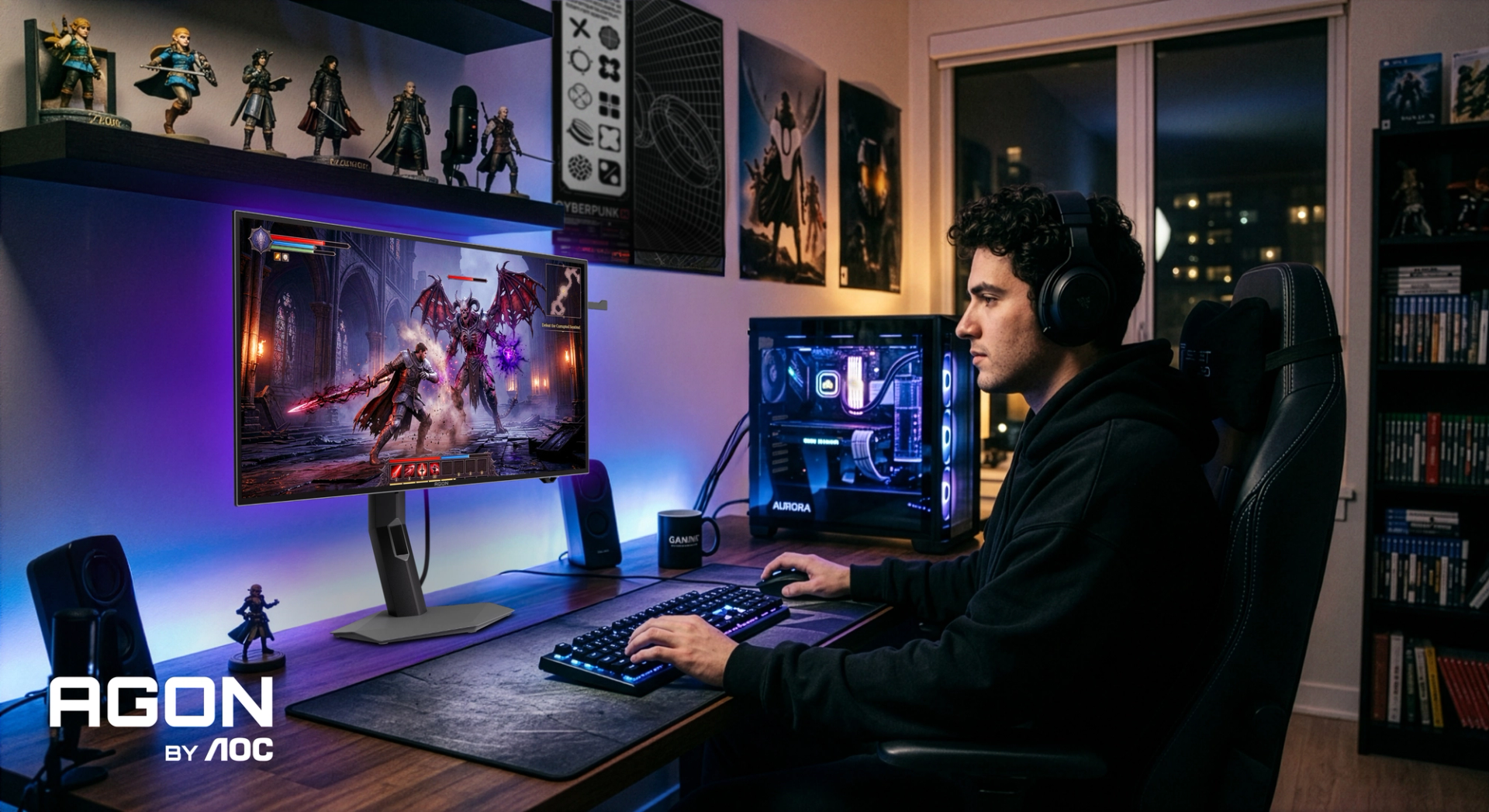
OLED is becoming an increasingly important part of gaming, but today's OLED gaming monitors are no longer defined by a single set of specifications. As the technology continues to evolve, different combinations of resolution, refresh rate, screen size, format and panel technology are emerging to suit very different ways of playing.
From cinematic, story-driven titles to fast-paced competitive games, different genres place different demands on a display. AGON by AOC, the world's leading gaming monitor brand¹, takes a closer look at how OLED technology is evolving across these use cases, and how QD-OLED and WOLED are expanding the possibilities available to gamers.
What makes OLED different?
Unlike an LCD display, where a backlight produces the light behind the image, every pixel in an OLED display generates its own light and can switch off individually. This enables true blacks, strong contrast and extremely fast pixel response, with current OLED gaming panels reaching response times as low as 0.03 ms GtG.
These fundamentals are shared across OLED displays. What differs is how they are combined with resolution, refresh rate, screen size and format to prioritise different gaming experiences.
"OLED is no longer about one type of gaming monitor," says César Acosta, Senior Gaming Product Manager at AGON by AOC. "The core benefits remain the same, but the technology is now being used in very different ways. That gives gamers more choice in finding the right balance of resolution, speed, screen size and format for the way they play."
Resolution Meets OLED Contrast
For visually rich games, resolution and screen size can be just as important as speed. Narrative-driven and open-world titles make extensive use of contrast, dark environments and detailed lighting, areas where OLED's pixel-level light control can make a noticeable difference.
For players prioritising this kind of experience, a 4K OLED monitor combines high resolution with OLED contrast and fast response. Screen size then shapes the experience further: a 31.5-inch 4K display offers a larger viewing area, while a more compact 26.5-inch 4K display concentrates the same resolution into a smaller screen for greater pixel density.
This shows how even monitors sharing the same resolution and refresh rate can deliver a different experience.
Speed Meets OLED Clarity
Competitive gaming shifts the priority towards speed. In fast-paced, competitive titles, higher refresh rates allow the display to present new frames more frequently, while OLED's rapid pixel response helps maintain clarity during fast movement.
A 1440p OLED monitor can therefore offer a different balance from a 4K display. At 27 inches, QD-OLED panels are now reaching refresh rates of 500 Hz, while other monitors offer 280 Hz with QD-OLED or 240 Hz with WOLED.
Refresh rates are being taken even further with Tandem OLED, which has reached a native 540 Hz at QHD resolution and up to 720 Hz in HD mode.
OLED development is also taking place within the emissive structure itself. Tandem technology uses multiple stacked emissive layers, distributing the workload required to produce light across the panel structure. This can improve efficiency, support greater brightness and reduce stress on individual organic layers over time. Rather than representing a separate type of OLED, Tandem is one of the developments within both QD-OLED and WOLED as these technologies continue to evolve.
Ultrawide Meets OLED Immersion
OLED has also expanded beyond the traditional 16:9 gaming monitor.
For racing, simulation and compatible open-world titles, a wider display can increase the amount of the game world visible at once. This can contribute to a greater sense of immersion and spatial awareness.
Curved 34-inch 21:9 QD-OLED displays, for example, combine WQHD resolution with refresh rates ranging from 175 Hz up to 360 Hz.
Moving to larger formats, a 44.5-inch curved 21:9 WOLED display at 240 Hz and a 48.9-inch curved 32:9 QD-OLED display with Dual QHD resolution at 240 Hz extend the experience further.
For these players, the choice is not simply about achieving the highest resolution or refresh rate. Screen format and field of view become part of the gaming experience itself.
Confidence beyond the game
As OLED becomes more established in gaming monitors, long-term use remains an important consideration. AGON by AOC supports its OLED gaming monitors with a three-year warranty that includes coverage for OLED burn-in, giving gamers additional reassurance when choosing their display.
OLED Care features provide another layer of protection during everyday use. Available functions vary by model and are designed to help reduce the effects of prolonged static content over time.
OLED is therefore not evolving towards one monitor specification for every gamer. Instead, the technology is expanding in different directions, giving players more choice between 4K detail, ultra-high refresh rates, compact competitive displays and immersive ultrawide formats.
As QD-OLED and WOLED continue to develop, the possibilities for how OLED can be used in gaming monitors are continuing to grow.
¹ In terms of sales volume, gaming monitors with 144 Hz+, IDC Research – Gaming Tracker Q1-Q4 2025.
Press contact
AOC International B.V.
Mafalda Levi Gonçalves
PR Coordinator
Prins Bernhardplein 200, 6th Floor
1097 JB Amsterdam, Netherlands
mafalda.goncalves@tpv-tech.com